
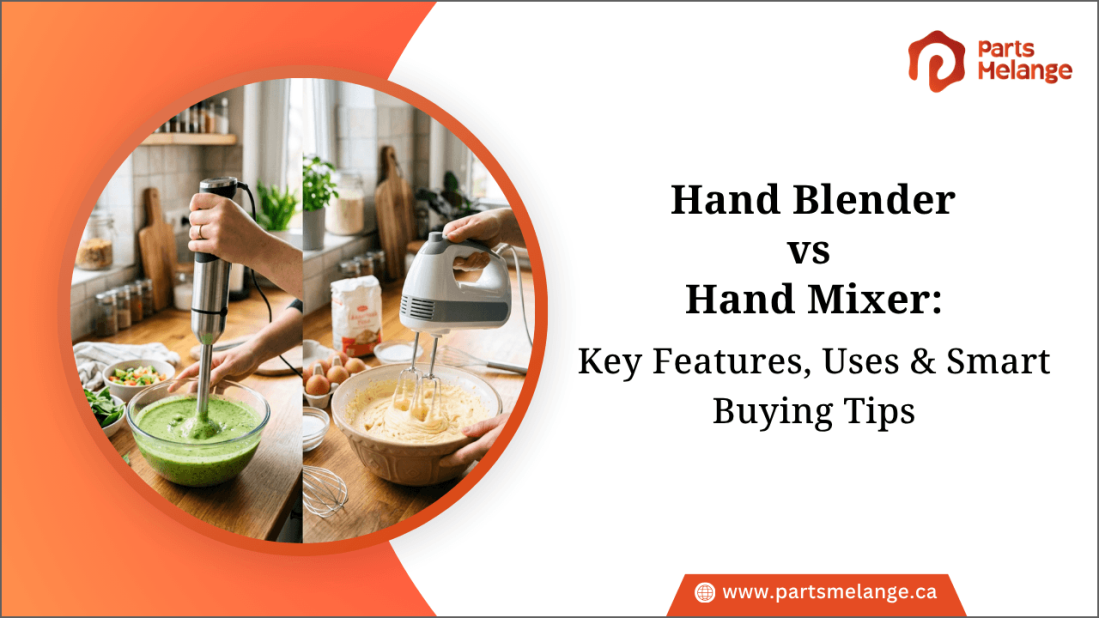
Hand blenders and hand mixers are widely used kitchen tools that help simplify everyday food preparation. While both are compact and easy to use, they are designed for different tasks. One focuses on blending and pureeing, while the other is ideal for mixing and whipping ingredients.
Understanding the differences between these two appliances is important to ensure better results and efficiency in the kitchen. Choosing the right appliance and maintaining essential home appliance components like blades, beaters, and attachments can also help ensure smooth performance over time.
This blog covers key features, uses, differences, and smart tips to help you choose the right appliance.
What Is a Hand Blender: Features, Functions, and Best Uses
A hand blender, often called an immersion blender, is a portable appliance used for blending, pureeing, and mixing ingredients right in the same container. It works using a motor in the handle that powers rotating blades at the bottom, allowing ingredients to be blended quickly without transferring them to another container. This makes it ideal for fast, convenient cooking with minimal cleanup.
Key Features of a Hand Blender
Hand blenders are built for ease of use, better control, and convenient everyday performance.
Compact Design: Lightweight and easy to handle.
Variable Speed Control: Helps achieve different textures with better precision.
Detachable Shaft: Makes cleaning and storage simple.
Multi-Purpose Attachments: Supports tasks like whisking and chopping.
Functions of a Hand Blender
A hand blender handles essential food preparation tasks efficiently.
Blending: Suitable for soups, sauces, and liquids.
Pureeing: Ideal for vegetables, fruits, and baby food.
Mixing: Works for light batters and ingredients.
Emulsifying: Helps combine ingredients for dressings and dips.
Best Uses of a Hand Blender
It is best suited for quick and simple kitchen tasks.
Hot Soup Blending: Blend soups directly in the pot without transferring.
Quick Smoothies: Prepare smooth and consistent drinks with ease.
Sauces and Chutneys: Make fresh condiments quickly and efficiently.
Everyday Cooking: Ideal for fast and convenient food preparation.
A hand blender is a practical tool for efficient cooking, especially when speed, ease of use, and minimal cleanup are important.
What Is a Hand Mixer: Features, Functions, and Best Uses
A hand mixer is a compact kitchen appliance used for mixing, beating, and whipping ingredients with ease. It is commonly used in baking and cooking tasks where consistent mixing is required, such as preparing batters, dough, and creams. Designed for control and efficiency, a hand mixer helps achieve smooth and even results with minimal effort.
Key Features of a Hand Mixer
Hand mixers are designed for consistent performance, ease of use, and efficient handling of a variety of mixing tasks.
Dual Beaters: Equipped with rotating beaters that ensure smooth mixing and proper aeration of ingredients.
Variable Speed Settings: Multiple speed options provide better control for different recipes.
Ergonomic Design: Lightweight and comfortable grip for easy handling during extended use.
Eject Button: Enables easy removal of beaters for cleaning.
Additional Attachments: May include dough hooks or whisks for versatile use.
Functions of a Hand Mixer
A hand mixer handles various mixing tasks efficiently, ensuring even and consistent results.
Mixing: Ideal for cake batters, cookie dough, and pancake mixes.
Beating: Suitable for eggs, butter, and sugar to achieve a smooth texture.
Whipping: Perfect for cream, frosting, and meringue with light and fluffy results.
Kneading (Light): With dough hooks, it can handle soft dough for basic baking needs.
Best Uses of a Hand Mixer
It is best suited for tasks that require thorough mixing and aeration.
Baking Preparation: Perfect for cakes, cookies, and pastries.
Whipping Cream: Achieves light and fluffy textures.
Frosting and Icing: Ensures smooth and consistent mixtures.
Everyday Mixing: Useful for regular kitchen tasks involving batter and dough.
A hand mixer is an essential tool for baking and mixing tasks, offering reliable performance and consistent results in everyday cooking.
Hand Blender vs Hand Mixer: Key Differences at a Glance
Hand blenders and hand mixers may look similar in size and convenience, but they are designed for different kitchen tasks. Understanding their key differences helps you choose the right appliance for better performance and efficiency.
Feature | Hand Blender | Hand Mixer |
Design | Slim handheld stick with a blending shaft and blades | Handheld unit with dual beaters or attachments |
Primary Function | Blending, pureeing, and emulsifying | Mixing, beating, whipping, and kneading |
Best For | Soups, smoothies, sauces, and liquids | Cakes, cookies, dough, cream, and frosting |
Attachments | Blending shaft, whisk, chopper | Beaters, dough hooks, whisk |
Texture Handling | Best for liquids and soft ingredients | Handles thick batters and semi-solid mixtures |
Usage | Used directly in pots, jars, or bowls | Requires a separate mixing bowl |
Speed Control | Basic to moderate speed options | Multiple speed settings for precise control |
Power Range | Lower to moderate power for light tasks | Higher power for heavy mixing tasks |
Cleaning | Easy, especially with a detachable shaft | More components to clean and maintain |
Storage | Compact and space-saving | Slightly bulkier due to attachments |
Ideal Use Case | Quick blending and small-batch tasks | Baking and detailed mixing tasks |
This comparison makes it easier to understand how each appliance fits different cooking needs, helping you choose the most suitable option for your kitchen.
How to Choose the Right Hand Blender and Hand Mixer
Choosing between a hand blender and a hand mixer comes down to how you use your kitchen tools and the kind of recipes you prepare. Understanding their purpose and performance helps you pick the right appliance for better efficiency and results.
Here are a few important factors to consider before making your choice.
Identify Your Cooking Needs: If you mainly prepare soups, smoothies, and sauces, a hand blender is the better choice. For baking, whipping cream, or mixing dough, a hand mixer is more suitable.
Consider Frequency of Use: For regular use, choose a model with durable build quality and reliable performance. For occasional use, a basic model with standard features will work well.
Check Power and Performance: Hand blenders require moderate power for light tasks, while hand mixers need higher power to handle thick batters and continuous mixing.
Look at Attachments and Versatility: Hand blenders may include attachments like a whisk or chopper for multi-purpose use. Hand mixers typically come with beaters, dough hooks, and whisks for different mixing needs.
Evaluate Ease of Cleaning and Storage: Hand blender parts are easier to clean and store due to fewer parts. Hand mixer parts may require more effort because of multiple attachments.
Set Your Budget: Choose a product that offers the best balance between features, performance, and price based on your usage.
Considering these factors will help you select the right appliance that matches your needs, improves efficiency, and delivers better results in your kitchen.
Explore How to Choose the Right Mixers & Blenders for Your Home Kitchen, including their types, key features, and common mistakes to avoid when selecting the best appliance for your needs.
Summary: Which One Should You Buy for Your Kitchen?
A hand blender or hand mixer should be chosen based on the type of tasks you perform most often in the kitchen. Hand blenders are better suited for soups, smoothies, and sauces, while hand mixers are more effective for mixing, whipping, and baking tasks.
Both appliances serve different purposes, so the right choice depends on your cooking style and usage. Understanding their differences helps you select the most suitable option for better efficiency.
Key Takeaways
A hand blender is best for blending, pureeing, and liquid-based tasks
A hand mixer is ideal for mixing, whipping, and baking needs
Choose based on your cooking habits and recipe types
Consider power, attachments, and ease of use before buying
Both appliances serve different purposes and are not interchangeable
Shop high-quality home appliance replacement parts at PartsMelange to keep your mixers and blenders running smoothly. Explore a wide range of components, including motors, beaters, blades, switches, and attachments, designed to ensure efficient performance and appliance durability.
FAQs
Can a hand blender replace a hand mixer?
No, a hand blender cannot fully replace a hand mixer. A hand blender is designed for blending and pureeing, while a hand mixer is better for mixing, whipping, and baking tasks.
Which is better for baking: hand mixer or hand blender?
A hand mixer is better for baking. It can mix batters, whip cream, and handle dough more effectively than a hand blender.
Is a hand blender good for whipping cream?
A hand blender can whip cream to some extent, but it may not give the same light and fluffy texture as a hand mixer.
Do I need both a hand blender and a hand mixer?
It depends on your cooking needs. If you do both blending and baking regularly, having both appliances can be useful. If not, choose one based on your primary usage.
| Disclaimer: This blog is for informational purposes only and is intended to provide general guidance on hand blenders and hand mixers. Actual performance and suitability may vary based on product model, usage, and maintenance. |







Please complete your information below to login.
Sign In
Create New Account