
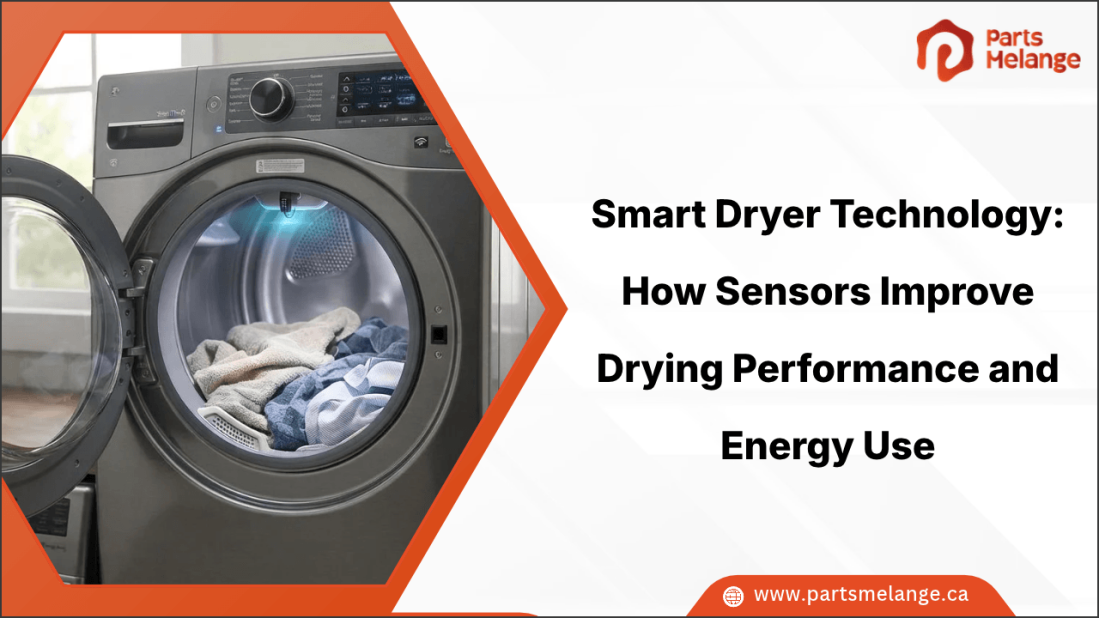
Modern dryers are moving beyond fixed-time cycles with smart technology that monitors moisture, temperature, and drying conditions during operation. Sensors provide real-time information to the control system, allowing the dryer to adjust heating and cycle duration based on the actual condition of the load.
This sensor-based approach can improve drying consistency, reduce unnecessary heat exposure, and help manage energy use. It also makes dryers more responsive to different load sizes, fabric types, and moisture levels.
This blog explains smart dryer technology, sensor-based drying, its impact on performance and energy use, and the factors that influence sensor operation.
Understanding Smart Dryer Technology and How It Works
A smart dryer measures the condition of the load during the cycle and uses those readings to control heat and end the cycle automatically. A regular dryer runs for a fixed time, whether or not the clothes are dry, which is why the same load can come out damp one day and over-dried the next.
A smart dryer works differently because it monitors the load while it dries. Sensors inside the drum measure moisture and temperature, and a control board uses that information to decide when to adjust the heat and when to stop the cycle. Many models also connect to Wi-Fi and a phone app, so you can start a cycle remotely, get an alert when the load is done, and run basic diagnostics.
A smart dryer typically works through these functions:
Cycle setup: You choose a cycle, a fabric type, and a dryness level such as less dry, normal, or very dry, and the control board sets a starting heat level.
Heating and tumbling: The dryer heats the air, the drum tumbles the clothes, and a fan moves moist air out of the drum.
Continuous checking: Throughout the cycle, the control board receives readings from the dryer's sensors and compares them with the dryness level you selected.
Heat adjustment: The board raises, lowers, or pauses the heat to match the fabric setting, so heat is not applied longer than the load needs.
Cycle completion: Once the selected dryness level is reached, the dryer stops heating, finishes with a cool-down, and signals that the load is done, with a phone alert on connected models.
This approach allows the dryer to adapt to the actual drying conditions rather than running the same amount of time for every load.
Which Sensors Are Inside the Dryer, and What Do They Do?
Smart dryers use multiple sensors and electronic components to monitor conditions throughout the drying cycle. Moisture sensors help detect changes in the dampness of clothes, while temperature sensors and thermistors provide information about heat levels. Other components can monitor airflow and send operating data to the control board.
The main sensors and components involved in monitoring drying conditions include:
Sensor or component | What it monitors | How it supports drying |
Moisture sensor | Electrical resistance across two metal strips in the drum | Helps determine when clothes reach the selected dryness level |
Temperature sensor (thermistor) | Air temperature at the exhaust outlet or near the heater | Lets the board cycle the heating element on and off to hold the heat set for your fabric type |
Humidity sensor | Measures moisture in the exhaust air | Helps judge dryness in loads that rarely touch the metal strips, such as a single comforter |
Airflow or vent sensor | Detects reduced exhaust airflow or pressure | Flags restricted airflow from a full lint filter or blocked vent, often with a "check vent" prompt |
Load-size sensor | Estimate load weight from drum motor effort or an initial moisture reading | Sets a starting cycle length and heat level based on the amount of laundry |
Electronic control board | Receives signals from all sensors | Processes the readings and controls heating, motor operation, and cycle timing |
Together, these sensors give the dryer continuous feedback during operation. The control system can use this information to adjust the drying process and determine when the load has reached the desired dryness level.
Better Drying Performance and Fabric Results With Sensor Technology
Sensor-controlled drying adjusts the cycle according to the moisture condition of the clothes rather than relying only on a fixed drying time. As the load becomes drier, the sensors send updated information to the control system, allowing the dryer to adjust heating and determine when the selected dryness level has been reached.
Less over-drying: The moisture strips detect rising resistance as water leaves the clothes, so the cycle ends at the chosen dryness level. This reduces shrinkage, stiffness, and static cling in cotton and blends.
Lower heat exposure: The thermistor lets the control board hold the temperature for the fabric setting and cut heat once the load is dry. This slows wear on the elastic in waistbands, activewear, and synthetics.
Accurate results on mixed loads: The cycle keeps running until the wettest items, such as towels, are dry, which means fewer damp spots and fewer rerun cycles.
Less lint and fiber loss: Shorter dry-tumbling time means less abrasion against the drum, so less fiber breaks off and collects in the lint filter.
Consistent finish: Each cycle ends on a measured result instead of a guess, so similar loads come out with the same dryness every time.
This approach helps the dryer adapt to different load sizes and fabric types while reducing unnecessary drying time. As a result, clothes can reach a more consistent finish with less excess heat and tumbling.
For example, LG dryers with Sensor Dry technology measure moisture levels during the cycle and automatically adjust drying time to help prevent unnecessary drying.
How Smart Dryer Technology Cuts Energy Use and Lowers Your Bills
A smart dryer can reduce energy use by limiting the time spent heating and tumbling clothes after they reach the selected dryness level. Instead of running for a fixed period, sensor-based drying uses moisture and temperature feedback to adjust the cycle. This can reduce unnecessary heating and help lower energy consumption over repeated loads.
Shorter Cycles and Fewer Repeat Loads: The dryer can stop or reduce active drying when clothes reach the target dryness.
For example, a load of towels that reaches the selected dryness level early does not need to continue heating for the remaining timed minutes.
Temperature Control and Heating Run Time: Thermistors monitor temperature and send feedback to the control board, which can cycle the heating element as needed. This helps avoid unnecessary heating when the load requires less heat.
ENERGY STAR and Heat Pump Dryer Efficiency: ENERGY STAR certified dryers use about 20% less energy than conventional models. Heat pump dryers can use up to about 50% less energy than conventional dryers because they recycle heat instead of continuously exhausting heated air. They typically dry at lower temperatures and may take longer.
Better Airflow, Shorter Drying: A clean lint filter and properly maintained vent help moisture escape efficiently.
For example, a restricted vent can extend drying time, causing the dryer to operate longer and use more energy.
Overall energy savings depend on the dryer type, load size, fabric, cycle setting, and airflow. When sensors and airflow work properly, the dryer can reduce unnecessary heating and drying time.
What Factors Can Affect Sensor-Based Dryer Performance?
Sensor-based drying depends on accurate sensor readings, proper airflow, effective heating, and correct operation of the dryer’s control system. If one of these areas is affected, the dryer may take longer to dry clothes, stop before the load is fully dry, or continue running longer than expected.
Several factors can influence sensor-based dryer performance:
Factor | Effect on Dryer Performance | What to Do |
Dirty moisture sensors | May cause inaccurate moisture readings | Clean the sensor surfaces regularly |
Restricted airflow | Slows moisture removal and increases drying time | Clean the lint filter and check the vent |
Faulty temperature sensor | Can affect temperature monitoring and heating control | Test the sensor and replace if faulty |
Damaged moisture sensor | May cause the cycle to end too early or run too long | Inspect and replace the sensor if damaged |
Load size or fabric type | Can lead to uneven drying or longer cycles | Use suitable load sizes and cycle settings |
Loose wiring | May interrupt signals between sensors and controls | Inspect and secure wiring connections |
Control board problem | Can affect sensor processing and cycle control | Test the board and replace if necessary |
Incorrect cycle selection | May produce unsuitable drying results | Select the cycle based on the load and fabric |
Keeping the sensors clean, maintaining proper airflow, and using suitable load sizes can help the dryer respond more effectively to changing drying conditions.
Check out the LG Dryer Troubleshooting Guide: Common Problems, Causes, and Solutions to identify common dryer issues, understand their causes, and find practical solutions.
Summary: How Smart Dryer Sensors Improve Efficiency and Performance
Smart dryer technology uses moisture sensors, temperature sensors, thermistors, and electronic controls to monitor drying conditions during each cycle. Instead of relying only on a fixed timer, the dryer can adjust heating and cycle duration based on the actual moisture level of the load.
Sensor-based drying can help improve drying consistency, reduce unnecessary heating and tumbling, and manage energy use. Proper airflow, clean sensors, suitable load sizes, and correctly functioning components also play an important role in maintaining dryer performance.
Key Takeaways:
Moisture sensors help detect when clothes are dry.
Temperature sensors help control heating during the cycle.
Sensor-based cycles can reduce unnecessary drying time.
Proper airflow supports efficient moisture removal.
Clean and functioning sensors help maintain consistent drying performance.
Shop trusted home appliance replacement partsby PartsMelange to support proper dryer performance and everyday appliance maintenance. Find dryer parts such as sensors, thermistors, heating elements, control boards, and more to improve appliance performance and keep your dryer operating efficiently.
Reference:
https://www.energy.gov/home-upgrades-pivot-table
https://www.energystar.gov/products/clothes_dryers/heat-pump-dryer
FAQs
Do dryer sensors save electricity?
Yes, sensor-based cycles can reduce energy use by limiting unnecessary heating and drying time. Actual savings depend on the dryer, load size, cycle setting, and usage habits.
Why is my sensor dryer taking too long to dry clothes?
Restricted airflow, overloaded loads, dirty sensors, unsuitable cycle settings, or faulty heating and temperature components can increase drying time.
How do I keep dryer moisture sensors working properly?
Keep the sensor surfaces clean and free from residue. Also maintain the lint filter and exhaust system to support proper airflow and drying performance.
Can sensor-based drying protect clothes?
Sensor-based drying can help limit unnecessary heat and tumbling by ending or adjusting the cycle when the selected dryness level is reached. This may reduce excessive drying compared with unnecessarily long timed cycles.
Disclaimer: This blog is for informational purposes only and provides general information about smart dryer technology. Information may vary depending on the dryer model, load type, and operating conditions. |



Please complete your information below to login.
Sign In
Create New Account