
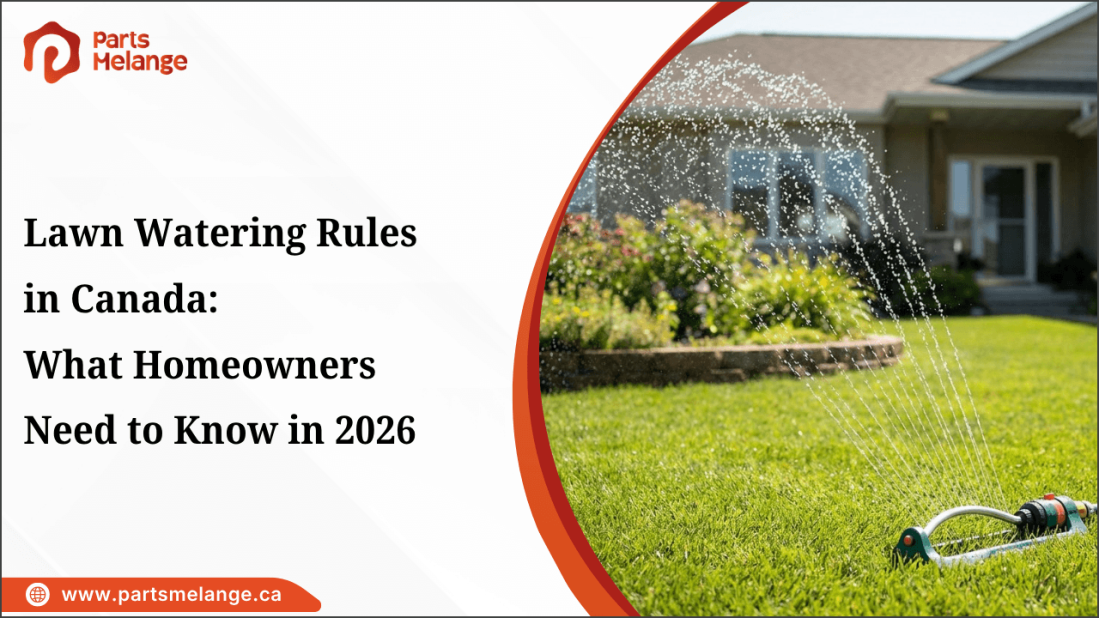
What Are Lawn Watering Rules?
Lawn watering rules in Canada are local regulations that govern lawn watering and outdoor water use. These rules are established by municipalities, regional districts, or local water authorities and can vary significantly across communities. They may include requirements for watering schedules, permitted hours, irrigation methods, drought restrictions, and exemptions for certain outdoor water uses.
Knowing your local watering schedule is important before using a sprinkler, hose, or automatic irrigation system. Rules can also differ for lawns, gardens, new sod, and other outdoor water uses, so homeowners should check the current requirements for their municipality rather than relying on a general Canadian schedule.
This guide explains lawn watering schedules, time restrictions, drought stages, permitted outdoor water use, and possible exemptions for new lawns, gardens, and alternative watering methods in Canada.
Why Lawn Watering Rules Differ Across Canadian Cities and Provinces
Lawn watering rules differ because municipalities manage local water distribution and establish outdoor water-use bylaws based on their own water sources, infrastructure, seasonal demand, and conservation requirements. A homeowner cannot assume that a rule used in one Canadian city applies in another city, even when both are in the same province.
Several factors determine the local rule:
Water supply: Communities supplied by reservoirs, rivers, groundwater, or smaller local systems can face different conservation pressures.
Summer demand: Sprinklers and automatic irrigation can create large increases in water demand during hot weather.
Drought conditions: Low rainfall, reduced snowpack, high temperatures, and declining water levels can trigger higher restriction stages.
Infrastructure capacity: A city may restrict outdoor water use temporarily during water-main repairs or other infrastructure work. For example, Saskatoon asked some east-side residents to avoid lawn watering and sprinkler use in spring 2026 while a major water-main project was underway.
Local conservation policy: Some municipalities impose a regular watering schedule even when there is no emergency shortage.
This means homeowners should check the specific municipality, regional district, or water utility serving their property, rather than relying on a general Canadian watering calendar.
What Lawn Watering Schedules and Time Restrictions Do Homeowners Need to Follow?
Municipal watering schedules usually specify which days homeowners can water, what time of day watering is permitted, and which irrigation methods are covered. The schedule may depend on the property address, type of property, or whether watering is done manually or with an automatic system.
For example, Langley City's Stage 1 schedule beginning September 1, 2026, allows residential properties with even-numbered addresses to water lawns on Saturdays and odd-numbered addresses on Sundays. Automatic watering is permitted from 5:00–7:00 a.m., while manual watering is permitted from 6:00–9:00 a.m.
Other municipalities use fixed weekdays, different address groups, or separate schedules for specific irrigation methods. Homeowners should therefore check the schedule that applies to their property before watering.
What Homeowners Should Check Before Watering
Watering days: Check whether your property can be watered on specific weekdays or according to an odd/even address system.
Permitted hours: Confirm the exact hours when watering is allowed, as automatic and manual watering may have different time limits.
Irrigation method: Automatic sprinklers, portable sprinklers, hand-held hoses, drip irrigation, and soaker hoses may be subject to different requirements.
Property type: Residential, multi-family, commercial, and institutional properties may follow separate schedules.
Restriction stage: A regular watering schedule may be replaced or tightened when drought-related restrictions are declared.
Address rules: Where an odd/even system applies, use the property's street address rather than assuming the rule is based on the unit number.
For example, Calgary's regular 2026 schedule allows even-numbered addresses to water on Tuesday, Thursday, and Saturday, while odd-numbered addresses can water on Wednesday, Friday, and Sunday. Its permitted watering hours also depend on the applicable watering schedule or restriction stage.
Homeowners using automatic irrigation should update their controller whenever municipal rules change so the programmed schedule matches the current permitted watering days and hours.
How Drought and Water Restriction Stages Can Change Lawn Watering Rules
Lawn watering rules can become stricter when drought, low water levels, prolonged heat, or unusually high demand puts pressure on a local water supply. Municipalities may respond by moving from normal conservation schedules to staged restrictions that progressively reduce outdoor water use.
A restriction stage can change more than the number of watering days. It may also reduce watering frequency, permitted hours, irrigation methods, and the types of outdoor activities allowed.
How Restriction Stages Can Tighten Watering
A municipality may introduce measures such as:
Reducing watering days: A schedule may change from several days per week to once weekly or every other day.
Shortening watering hours: Permitted watering windows may become narrower.
Limiting irrigation methods: Automatic systems, sprinklers, or certain hose attachments may face additional restrictions.
Restricting lawn watering: Established lawns may have limited watering opportunities or face a complete watering ban at higher stages.
Expanding restrictions: Rules may also cover vehicle washing, driveway cleaning, pool filling, and other outdoor water uses.
Suspending exemptions: An exemption available under a lower stage may be changed or removed under more severe restrictions.
For example, the Regional District of Nanaimo (RDN) uses staged water restrictions. Under higher stages, residential lawn watering becomes less frequent, with Stage 2 applying an every-other-day schedule based on property address. More severe stages can prohibit lawn watering altogether.
What Homeowners Should Do When a Restriction Stage Changes
When a new stage is announced, homeowners should check the effective date and review the updated requirements rather than continuing with their existing irrigation schedule. Automatic sprinkler controllers should be reprogrammed, and any newly prohibited outdoor water use should be stopped immediately.
Restriction stages are location-specific, so homeowners should use the latest notice from their municipality, regional district, or water utility to determine the rules that apply to their property.
What Outdoor Water Use Is Allowed and Prohibited During Restrictions?
Outdoor water restrictions can apply to more than lawn sprinklers. Depending on the municipality and restriction stage, rules may cover gardens, trees, shrubs, pools, vehicles, driveways, sidewalks, decorative features, and irrigation systems. The restrictions can also change as a municipality moves to a higher stage.
Lawn Watering During Restrictions
Lawn watering is often limited first because established turf can tolerate reduced irrigation. Under the RDN's 2026 Stage 2 restrictions, for example, even-numbered properties can sprinkle on even calendar days and odd-numbered properties on odd calendar days, for a maximum of two hours during permitted time windows. Vegetable gardens and drip irrigation systems are exempt under that Stage 2 rule.
At a higher restriction stage, lawn watering may be prohibited completely. The RDN's Stage 4 framework includes a sprinkling ban, meaning lawn watering is not permitted.
Other outdoor activities may also be restricted
Depending on the restriction stage, municipalities may regulate:
Outdoor water use | Possible restriction |
Lawn sprinklers | Limited days, hours, or completely prohibited |
Gardens and plants | May remain permitted with specific watering methods |
New lawns | May receive a limited exemption at lower stages |
Vehicle washing | May be restricted or prohibited |
Driveway and sidewalk washing | Commonly prohibited unless required for health or safety |
Pools and hot tubs | May be permitted at lower stages but prohibited at higher stages |
Fountains and decorative features | Often restricted or prohibited |
Automatic irrigation | May require specific days and operating hours |
For example, Calgary's Stage 2 rules allow some lawn and landscape watering on a designated schedule but prohibit outdoor vehicle washing and washing down sidewalks, driveways, and other outdoor surfaces except where required for health or safety.
Do not assume every outdoor use is banned
Restrictions are stage-specific, so a prohibition on one activity does not necessarily mean every outdoor water use is prohibited. Calgary, for instance, allows some hand watering and watering of edible food crops under certain stages while restricting sprinkler-based lawn irrigation.
Homeowners should therefore check the specific activity and restriction stage rather than treating a municipal notice as a blanket ban on all outdoor water use. A method that is permitted during Stage 1 or Stage 2 may become prohibited when the municipality moves to a higher stage.
Can New Lawns, Gardens, and Alternative Watering Methods Be Exempt From the Rules?
Sometimes, but not automatically. Municipalities may give new lawns, gardens, and certain watering methods different treatment because newly established plants can need additional water. However, these allowances usually have specific conditions, time limits, or permit requirements.
New Lawns May Require an Exemption Permit
New sod and seeded lawns may qualify for additional watering while they become established. In some municipalities, homeowners must obtain a permit, while others provide a defined exemption period.
For example, the Capital Regional District allows new sod to be watered during specified hours for the first 21 days after installation. Newly seeded lawns can receive additional watering until growth is established or for 49 days after installation, whichever is less.
Calgary also provides special allowances for newly installed sod and newly seeded grass, although permitted watering can become more limited under higher restriction stages.
Gardens May Have Different Rules Than Lawns
Vegetable gardens, flowers, trees, and shrubs may be subject to different watering requirements than established turf.
For example, the Capital Regional District allows established trees, shrubs, flowers, and vegetable gardens to be watered by hand or micro/drip irrigation at certain stages, while sprinkler watering remains subject to specified hours.
This makes the watering method important. Switching from a sprinkler to drip irrigation may provide more flexibility for some gardens, but it does not automatically exempt the property from local restrictions.
Are Rain Barrels and Alternative Water Sources Exempt?
Using collected rainwater can reduce the amount of treated municipal water used for lawns and gardens. However, homeowners should check local requirements before assuming that rainwater or another alternative source is exempt from all outdoor-water restrictions.
The same applies to:
Rain barrels
Cisterns
Greywater systems
Drip irrigation
Soaker hoses
Smart irrigation controllers
An alternative water source or water-efficient device can reduce water consumption without automatically changing what the local bylaw permits.
Summary: How Canadian Homeowners Can Follow Lawn Watering Rules
Lawn watering rules in Canada vary by municipality and can change with seasonal demand, drought conditions, and water restriction stages. Homeowners should check their local watering days, permitted hours, irrigation requirements, and any rules that apply to new lawns, gardens, or alternative watering methods.
Following the current local schedule helps homeowners avoid prohibited outdoor water use while maintaining their lawns responsibly. When restrictions become stricter, adjusting automatic irrigation systems and using permitted water-efficient methods can help reduce water use without violating local requirements.
Key Takeaways
Check your municipal watering schedule before watering.
Follow the assigned watering days and permitted hours.
Check whether automatic and manual watering have different rules.
Understand how drought stages can tighten watering restrictions.
Verify whether new lawns or gardens qualify for exemptions.
Do not assume drip irrigation, rain barrels, or other methods are automatically exempt.
Update automatic irrigation controllers when local rules change.
Shop trusted home appliance replacement parts at PartsMelange to keep your appliances working efficiently. Find quality replacement components for lawn mowers, power tools, HVAC systems, and more to support repairs, maintenance, and everyday equipment performance.
References:
https://www.langleycity.ca/city-services/engineering-parks-operations/water-restrictions
https://www.calgary.ca/content/www/en/home/water/drought/lawn-watering-schedule.html
https://rdn.bc.ca/watering-restriction-map
https://www.crd.ca/environment/water-conservation/watering-schedule
FAQs
1. What are the lawn watering rules in Canada in 2026?
Lawn watering rules vary by municipality. They may specify permitted watering days, hours, irrigation methods, and restrictions based on the property's address or current drought stage.
2. What time of day is best to water a lawn during watering restrictions?
The permitted time depends on the local bylaw. Many municipalities restrict watering to specific morning or evening hours, so homeowners should follow the current schedule for their property.
3. Can I water my lawn during a drought restriction in Canada?
It depends on the restriction stage. Lower stages may allow watering on designated days and hours, while higher stages can limit or completely prohibit lawn watering.
4. Are new lawns exempt from lawn watering restrictions in Canada?
Some municipalities provide temporary exemptions or permits for newly seeded lawns and new sod. Eligibility, watering limits, and permit duration vary by municipality and restriction stage.
Disclaimer: This blog is for informational purposes only and provides general guidance. Lawn watering rules vary by municipality and may change based on local conditions. |







Please complete your information below to login.
Sign In
Create New Account